If you are in immediate danger, call 911.

If the individual who committed a crime against you was sentenced to prison and not probation, please contact the Arizona Department of Corrections Rehabilitation & Reentry, Victim Services Department.

Protective Orders

Learn how to obtain a protective order including Order of Protection or Injunction Against Harassment.

Frequently Asked Questions

Waiting for restitution payments can be frustrating and upsetting. Please know that a delay in payment does not mean your case has been forgotten or that restitution has been denied.

One common reason for a delay is that the court may not have your current mailing address. If your contact information has changed, payments may not reach you. You can update, or confirm, your address with the Criminal Financial Obligations (CFO) Unit at 602-372-5375 or coccforesponse@maricopa.gov, and you are encouraged to notify them of any future changes to help prevent delays.

In some cases, payments may be delayed because the individual ordered to pay restitution has not made payments as ordered.

If your restitution is connected to a count for which the offender was sentenced to prison, the Adult Probation Department does not have jurisdiction over the case. You can contact the Criminal Financial Obligations (CFO) Unit at 602-372-5375 or coccforesponse@maricopa.gov to discuss filing a Criminal Restitution Order.

While the offender is in prison, you can also contact ADCRR Victim Services at 602-542-5309 or azvictims@azadc.gov to obtain information about the inmate and restitution.

If the Presentence Investigation Officer did not receive your restitution information before sentencing, you may still be able to request restitution. This depends on whether restitution is still open in your case, meaning the judge’s deadline for restitution requests has not passed.

How do I know if restitution is still open?
You can contact the Probation Officer assigned to the case to find out whether restitution is still available or contact the Adult Probation Department Victim Service Unit (APD VSU) at 602-619-2955 or apdvsu@jbazmc.maricopa.gov.

What should I do if restitution is still open and I would like to request restitution?
Let the assigned Probation Officer know that you would like to request restitution. The officer can explain the process and provide information on next steps. 

What information will I need to provide?
You will need documentation showing your financial losses related to the crime, such as bills, receipts, repair estimates, or medical bills. You may also be asked to provide a summary of your request. 

What happens after I submit my request?
The Probation Officer will submit documents to the court providing information regarding your request. If the judge grants the request, the probationer will be ordered to pay the restitution amount set by the court.

Who can I contact if I don’t know which Probation Officer is assigned to my case?
You may contact the APD VSU at 602-619-2955 or email apdvsu@jbazmc.maricopa.gov for assistance.

Yes. If you have new, additional, or future costs related to the crime, you may be able to request that restitution be modified. This can include expenses such as ongoing medical care or counseling.

To request additional restitution, send documentation showing your losses to the Probation Officer assigned to your case. The Probation Officer will review and provide the information to the Court. If you don't know the probation officer assigned to your case, contact the APD Victim Services Unit at 602-619-2955 or email apdvsu@jbazmc.maricopa.gov for assistance.

Important things to remember: The Judge sets a deadline for how long restitution can remain open, so it is important to make your request for restitution as soon as possible.

Proof is required: You must be able to prove your financial losses with documentation.

Only the Court has the authority to change, add, or modify restitution.

If you have opted in to receive notifications, the Probation Officer assigned to your case will notify you of any change to the restitution amount. If you have questions or concerns about a reduction in restitution, you are encouraged to contact the assigned Probation Officer, who can review the change with you and provide additional information.

If your restitution is connected to a count for which the offender was sentenced to prison, the Adult Probation Department does not have jurisdiction over the case. You can contact the Criminal Financial Obligations (CFO) Unit at 602-372-5375 or coccforesponse@maricopa.gov to discuss filing a Criminal Restitution Order.

While the offender is in prison, you can also contact ADCRR Victim Services at 602-542-5309 or azvictims@azadc.gov to obtain information about the inmate and restitution.

If the individual is actively on probation, the Probation Officer works with them to encourage and support restitution payments. This can include explaining the importance of making restitution a priority, helping them find employment or job training, providing budgeting or financial management guidance, and monitoring their payment progress through the Department’s Financial Compliance Unit.

The Probation Officer will notify the Court if the probationer is two full months behind in restitution payments, and again if payments are four full months behind. In some cases, the probationer may also be enrolled in the Tax Intercept Program, which can use their tax refund to help pay restitution.

If the Court finds that the probationer has willfully chosen not to pay, the judge can require the probationer to explain the nonpayment, hold them in contempt of court, impose a jail term, extend probation, order wage garnishment, or require community service.

To help improve the chances of receiving restitution, victims may choose to file a restitution lien or apply for the Victim Compensation Program.

For more information, you may contact the Law Library Resource Center in person or online.

Even if the probationer completes or is discharged from probation, any restitution still owed remains their responsibility. Depending on the case, the probationer may have their probation extended, remain on standard probation, or be modified to unsupervised probation while restitution is still owed.

If the restitution balance remains unpaid after probation ends, the Probation Officer will file a Criminal Restitution Order (CRO) with the Court for each individual or business victim entitled to restitution.

The Court can order that any remaining restitution be collected while the probationer is in prison. During this time, the Adult Probation Department no longer has jurisdiction over the individual or the restitution.

While incarcerated, the ADCRR can automatically deduct money the probationer earns to pay towards restitution. When the individual completes their prison sentence, a Criminal Restitution Order (CRO) will be issued for any unpaid restitution.

For information about the inmate or restitution while they are in prison, you may contact the ADCRR Victim Services at 602-542-5309 or azvictims@azadc.gov.

No. Court-ordered restitution is not dischargeable in bankruptcy. The restitution remains owed and must still be paid in full.

If a victim passes away before restitution is fully paid, the money will go to the victim’s established trust or estate. The victim’s next of kin will need to file a motion with the Court, including the death certificate and trustee information. The Court will determine the amount of restitution to be paid and establish the payment schedule.

For more information, you may contact the Clerk of the Court Criminal Financial Obligations Unit at 602-372-5375 or coccforesponse@maricopa.gov or visit the Law Library Resource Center in person or online.

Yes. The Court can order that any remaining restitution be collected while the probationer is in prison. During this time, the Adult Probation Department no longer has jurisdiction over the individual or the restitution.

While incarcerated, the ADCRR can automatically deduct money the probationer earns to pay towards restitution. When the individual completes their prison sentence, a Criminal Restitution Order (CRO) will be issued for any unpaid restitution.

For information about the inmate or restitution while they are in prison, you may contact the ADCRR Victim Services at 602-542-5309 or azvictims@azadc.gov.

A Criminal Restitution Order is issued by the Court when a defendant completes their probation or prison sentence and still owes restitution.

A CRO works like a lien on the individual’s personal property, similar to a restitution lien. It can be used to collect money from tax refunds, lottery winnings, trustee sales, or victim judgement awards. A CRO is recorded and enforced like a civil judgement, does not require renewal, does not expire and cannot be excused until the restitution is fully paid.

For more information, you may contact the Law Library Resource Center in person or online.

A restitution lien is an official claim on a person’s property that helps you collect restitution you are owed. It can be placed on a person’s house, vehicle, or personal property. A lien can be filed after restitution has been ordered but only before a Criminal Restitution Order (CRO) has been issued, making it a useful tool to help collect restitution. Once restitution is fully paid, the lienholder is responsible for releasing the lien.

Who can file a lien? Any person entitled to restitution under a court order may file a restitution lien. There is no fee required.

How do I file a lien? To access Restitution Forms and Instructions online at www.azcourts.gov/restitution/Victim-Restitution/Restitution-Forms or visit the Law Library Resource Center in person or online.

Yes, you can file a civil lawsuit related to the crime, even if restitution has been ordered. A civil case may include damages that are not covered by restitution. However, you cannot recover for the exact same losses twice. Any amount you receive through restitution or a civil judgment may be credited against the other. You may wish to consult a private attorney regarding your specific situation. In addition, to access Civil Law information online go to www.azcourts.gov/selfservicecenter/civil or visit the Law
Library Resource Center in person or online.

The Victim Compensation Program helps crime victims and their families cover certain expenses related to the crime. These can include medical or mental health expenses, funeral expenses, or lost
wages. Not all victims qualify.

To review the eligibility requirements online, visit Victim Compensation Program Eligibility Requirements (PDF).

To apply online, visit the Arizona Criminal Justice Commission Victim Compensation Application Portal.

For more information on the Victim Compensation Program, visit the Maricopa County Attorney's Office Victim Services page.

For reference, download a PDF of the frequently asked questions.

If you have additional questions, please contact the APD Victim Services Unit at 602-619-2955 or email apdvsu@jbazmc.maricopa.gov

Victim Services Agencies

Alliance for Justice

Amberly's Place (Yuma, AZ)

Area Agency on Aging


Arizona Adult Protective Services 

Arizona Adult Protective Services (APS) is a program within the DES Division of Aging and Adult Services (DAAS) and is responsible for investigating allegations of abuse, exploitation and neglect of vulnerable adults.

Phone: 877-767-2385 

View Now


Arizona Coalition for Victim Services (ACVS) 

The Arizona Coalition for Victim Services (ACVS) provides education, training, and advocacy to crime victim service providers throughout Arizona to improve the quantity and quality of services provided to victims in our communities. ACVS also promotes and protects the rights of victims through leadership, advocacy and community education.

View Now

Arizona Coalition to End Sexual and Domestic Violence

Phone: 602-279-2900 or 800-782-6400

View Now

Arizona Department of Corrections, Rehabilitation and Reentry - Victim Services

866-787-7233 or 602-542-1853

View Now


Arizona Law Help

Arizona Sexual Assault Network 

View Now

Arizona State Registered Sex Offenders

Arizona Voice for Crime Victims 

480-600-2661

View Now


AZPOINT Protective Orders 

Join a guided interview to help you fill out forms you'll need to ask for an Order of Protection, an Injunction Against Harassment, or an Injunction Against Workplace Harassment at an Arizona court. There is no fee to use AZPOINT at azpoint.azcourts.gov 

View Now

Center Against Family Violence (Mesa)

Center Against Sexual Assault

Child Abuse Prevention

Child Help 

Phone: 800-422-4453

View Now


Children's Bureau

Chrysalis 

Phone: 602-955-9059 and 602-944-4999

View Now


City of Phoenix - Victim Services Division

Phone: 602-534-2120

View Now


Community Referral

Crime Victims Legal Assistance Project

Department of Health Services

Empact Sexual Assault Services

Empact Suicide Prevention

Family Advocacy Center (Phoenix)

Federal Trade Commission Hotline

Fresh Start Women's Foundation

Give Back a Smile

Hope Center - Counseling

Maricopa County Bar Association Lawyer Service 

602-257-4200

View Now


Mothers Against Drunk Driving

Mr. Lockout

National Center for Missing/Exploited Children

National Center for Victims of Crime

National Center for Treatment/Prevention of Child Abuse

National Children's Alliance

National Coalition Against Domestic Violence

National Fraud Information Line

National Organization for Victim Assistance

National Sexual Violence Resource Center

Office for Victims of Crim

Parents Anonymous

Parents Assistance Hotline

Parents of Murdered Children AZ Chapter

Prehab

Rape, Abuse, Incest National Network

SAAF

Southern AZ Against Sexual Assault

Stalking Resources with SPARC

Voice for Victims

West Valley Advocacy Center

Understanding the Restitution Process

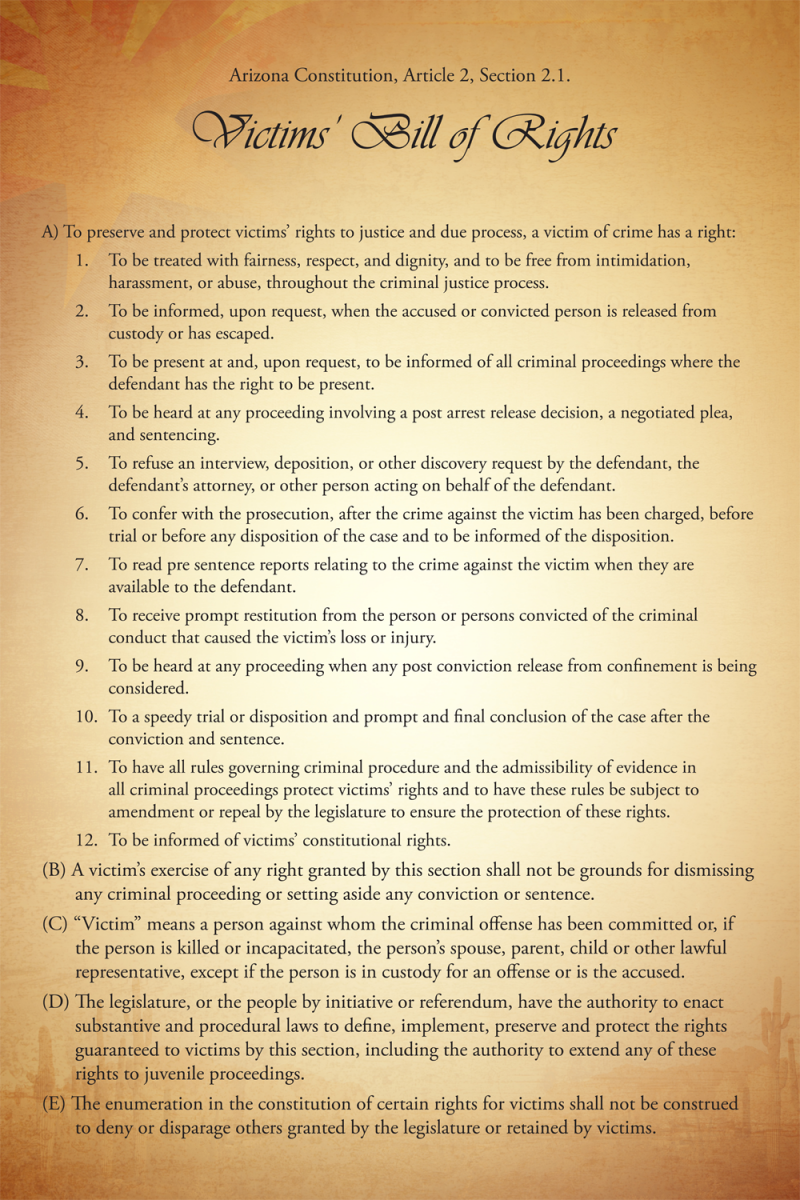
Arizona law states victims have the right to request restitution and receive prompt payment (A.R.S. §13-804). In most cases, the victim or company will speak to the pre-sentence investigator to request restitution. A victim may also be eligible for Restitution Liens.

Understand the restitution process and what you can expect as your case moves through probation supervision.

Arizona law requires people convicted of a crime to pay back victims for financial losses directly caused by the crime. This is called restitution. Victims have the right to request restitution and to receive payment as promptly as possible under A.R.S. §13‑804. Restitution cannot be dismissed through bankruptcy. 

Restitution is not automatically ordered when a defendant signs a plea agreement with the County Attorney.

If a victim wants restitution and it has not been ordered through the Court, it is very important a victim makes the request in a timely manner.

For restitution to be valid, it must be ordered by a judge and contained on a Court minute entry.

An Arizona law signed in 2018 gives the probation department jurisdiction to request a restitution hearing for the period of the probation term (A.R.S. § 13-810). If the defendant is sentenced to the Arizona Department of Corrections, Rehabilitation, and Reentry the County Attorney has jurisdiction to request a restitution hearing. If restitution is not ordered and there is no other court stipulation to keep restitution open, the County Attorney can lose jurisdiction. If the defendant is released from probation or parole, jurisdiction no longer exists for the Court to order restitution. The only remedy for the victim in both these scenarios is to file a civil claim against the defendant.

In Arizona, restitution liens are available to all victims of crime who have been awarded restitution by a Judge. There are two types of liens: Liens that a victim may file on their own (A.R.S. §13-806) and criminal Restitution Orders that the court files (A.R.S. §13-805). Both are civil judgments and can be filed against a defendant’s property or future property, such as a home or land, and against currently owned vehicle, such as a car, truck, boat, ATV, etc. A victim can file a lien once a Judge orders restitution. The victim becomes the lien holder and is responsible for releasing the lien once the restitution is paid in full. A victim wishing to file their own lien can contact the Law Library Resource Center. The Criminal Restitution Order is filed only upon absolute release from the Arizona Department of Corrections, Rehabilitation, and Reentry (parole must be completed), they have absconded from probation, or upon termination of probation. Once filed, the County Collection Unit can intercept Arizona Income Tax Refunds, lottery winnings, excess from trustee sales, and civil judgment awards. The unit will continue to report the lien to all major credit bureaus. After 120 days, the County Collection Unit will outsource a portion of the order to private collectors and eventually garnish wages.

Restitution is not automatic. A judge must order it, and it must appear in a Court minute entry. Victims usually request restitution during the pre‑sentence investigation, but it must be requested before the court loses jurisdiction.

Probation may request a restitution hearing while the individual is on probation (A.R.S. §13‑810). If the individual is in state prison, the County Attorney must request the hearing. Once an individual finishes probation or parole, the court can no longer order restitution, and victims may need to pursue a civil lawsuit. 

After the court sets the restitution amount, a payment plan is created if the individual cannot pay in full. APD monitors the individual’s payments during probation, ensures they follow the court‑ordered plan, and takes enforcement actions when needed. If a Criminal Restitution Order (CRO) is filed, the County Collection Unit may intercept tax refunds, report the debt to credit bureaus, send accounts to private collectors, and garnish wages when allowed.

Once restitution is collected, payments are processed and sent to victims. Delays can occur for several reasons, such as: 

  • The individual being supervised is not making payments consistently
  • Waiting for court orders or hearing outcomes
  • Processing times for intercepted funds like tax refunds or lottery winnings
  • Information updates needed for mailing or victim accounts 

After the court determines the amount of restitution, a payment plan will be set up if the individual cannot pay the lump sum. If there is an objection to the amount requested or if the Court or Probation Department are unable to determine an amount, the Court may keep restitution open or set a date for a restitution hearing. Restitution is non-dischargeable through bankruptcy (A.R.S. §13-603).

Victims may contact APD to check the status of their restitution account, confirm payments received, update mailing information, or ask questions. APD Restitution Specialists can review the account and provide the most current information available.

APD Victim Services Unit

602-619-2955  

apdvsu@jbazmc.maricopa.gov  

How to Sign Up for Victim Notifications (Opt In/Opt Out)

Victims who wish to receive post-conviction notifications may contact the prosecuting agency that handled their case, such as the Maricopa County Attorney's Office or the Arizona Attorney General's Office and request a Post-Conviction Notification Request (PCNR) form. This form is only available upon request. After completing the form, victims must submit the PCNR to the agency from which they wish to receive notifications. The completed form may be returned by mail or email, as directed by the receiving agency. IMPORTANT: If you wish to receive notifications regarding a probation case supervised by the Maricopa County Adult Probation Department, a copy of the completed PCNR form must be submitted directly to the Adult Probation Department Victim Services Unit. Submitting the form to another agency will not automatically enroll you to receive notifications from the Adult Probation Department.

Maricopa County Attorney's Office's Victim Resources

Maricopa County Attorney's Office's Victim Resources

Post-Conviction Notification Request: If you have not opted in as a victim in a criminal case, please contact the Maricopa County Attorney’s Office.

Arizona Attorney General's Office Victim Resources

Arizona Attorney General's Office Victim Resources

Post-Conviction Notification Requests: If you have not opted in as a victim in a criminal case, please contact the Arizona Attorney General's Office.

Questions about Adult Probation Victim Services?

Victim Services Unit 
602-619-2955 | apdvsu@jbazmc.maricopa.gov


Disclaimer: 
This page is for informational purposes only. For case-specific details, please contact the Victim Services Unit at apdvsu@jbazmc.maricopa.gov or the assigned Probation Officer.